
Showing posts with label media influence. Show all posts
Showing posts with label media influence. Show all posts
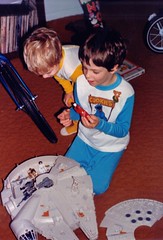
My first Star Wars toys
Originally uploaded by Mike McInnis
Not so long ago, the average American man in his 20s had achieved most of the milestones of adulthood: a high-school diploma, financial independence, marriage and children. Today, most men in their 20s hang out in a novel sort of limbo, a hybrid state of semi-hormonal adolescence and responsible self-reliance. This "pre-adulthood" has much to recommend it, especially for the college-educated. But it's time to state what has become obvious to legions of frustrated young women: It doesn't bring out the best in men.
That opens a Wall Street Journal lamentation by author Kay Hymowitz, and though I want to scream a) people should give this subject a rest, and b) how she's full of shit, she has a point. While I'm torn between raging in agreement with and balking against at the idea that guys are increasingly trapped in this slightly loser-ish bubble, I can't pretend I don't dip a toe in it. Sure, I'll read Jean Toomer and some Zora Neale, but the Star Wars DVDs aren't too far away. I volunteer with homeless children, but recently got the worst (and most humiliating) reprimand of my life for acting like a jackass. It's life, and people make mistakes that sometimes include collapsing beneath a juvenile impulse. The conflict comes when we don't grow from (and out of) our foolish decisions.
The causes behind questionable behavior are myriad, but what if there was a generational culprit? Hymowitz' emphasis on how naturally unrooted our peers are seems strikingly plausible: we "write [our] own biographies," travel abroad, and study longer and harder than before in pursuit of the questionable stability higher educated provides. Anecdotes and warnings on the importance of "getting out there while you still can" saturated our pivotal years to a point where settling down became shorthand for a type of failure. On one hand, this allows us to see and experience a world much larger than our parents, the trouble becomes finding where you actually fit within this greatly expanded landscape. Arrested development is just a side effect, and our cultural taste in entertainment -- the Xboxes, the useless apps, Transformers 3 -- just further signifies our commitment to staying forever young.
GQ occasionally gets called to task for being one of the "lad mags" that fuel our gendered problem, but the February 2011 issue features a great essay by Mark Harris highlighting the problem with our entertainment, Hollywood specifically: story comes second to marketing, and the products that sell are those that appeal to the largest group of spenders: teenagers. "Good movies aimed at adults tend to make their money more slowly than kid stuff," so kid stuff dominates. After that, of the "four quadrants" -- male and female, young and old -- of movie marketing, young and male by far makes the most money. Quoting Harris, "That's why, when you look at the genres that currently dominate Hollywood—action, raunchy comedy, game/toy/ride/comic-book adaptations, horror, and, to add an extra jolt of Red Bull to all of the preceding categories, 3-D—they're all aimed at the same ADD-addled, short-term-memory-lacking, easily excitable testosterone junkie. In a world dominated by marketing, it was inevitable that the single quadrant that would come to matter most is the quadrant that's most willing to buy product even if it's mediocre."
So now, we have a feedback loop that convinces me these trends are feeding off of each other: we stay young and lost, and steadily eat up entertainment that keeps us lost and young. There's a pretty direct route from Animal House to Ferris Bueller, to American Pie, to (sigh) "The Situation," and that picture will only get more absurd as the entertainment industry becomes more insulated and afraid.
To that end, I wonder if we'll ever change? Real-world obligations to becoming better/actual men aside, it's not like we're running out of teenagers, Children of Men style (although our societal craving for infinite youth would only get worse in that situation), so our entertainment will largely be designed to cater to them. Even the amazing, largely original, and video game-esque Inception could have been more "adult," if you will. Our only refuge, then, is TV, specifically, cable*: Mad Men, Breaking Bad, Rubicon (R.I.P.), Terriers (R.I.P.), Justified, mature dramas with the kind of intrigue we would ideally want from movies, the majority of which featuring male leads fully aware of their responsibilities to the world, and the consequences of their actions (even if they're running away from them).
But then what? Those shows are, well, TV shows, and how we occupy free time can't be the only key to bettering our behavior. It'd be insulting to suggest otherwise. Here's the question, then: if it seems our elders are caught in a cycle of utter insanity, our middle-agers are fueling some greed-induced reversion to infinite childhood, and our young men are, well, forever young, who exactly do we look toward to become better? Seems the women are ready to leave us behind.
*I won't completely discount network TV. I've recently become a massive fan of The Chicago Code, and not just because Jennifer Beals makes my heart go thump.

“We wanted to get you the doll but the store sold out of the black ones.”
I was well acquainted with “Christie” when I was a child; it was imperative to my mother for me to only own the “black Barbie” as opposed to her blond-haired blue-eyed counterpart. I always found this unfair because all of my dolls looked alike except for their separate outfits and respective functions, but my mother wanted my standards of beauty to be set by images that resembled both me and my culture, and although this may have not been the best method to do so, her intentions were in the right place.
Every female image I was surrounded by set forth a philosophy that was all but normal, classifying beauty by unrealistic standards concerning weight, height, skin color, and hair texture. Not only are women criticized by the physical attributes that we are born with, we are also forced to endure the lashing tongues of the prejudice within our own cultures.

For years I thought that these types of commercial propaganda only affected little black girls like me, but it was ignorant to think so. As I grew older and our society grew into the millennium the female image transformed: clothes became tighter and more revealing, hair straighter, heels higher and the popular skin color of preference became a frightening shade of Ritz cracker…tan but not "too" dark. With time I became introduced to women of different nationalities, ethnicities and cultures to find that not only were they under the same pressures that I had been dealing with my entire life, they were subject to the same unrealistic standards of beauty. Not to be confused, all of these women are gorgeous, but it was the ugly images in the media that made them feel insecure about all of the traits that make them uniquely beautiful. Scrutinized for anything from the size of their waist, feet and face; crease in their eyelids, arch in their nose, texture of their hair, and the shade of their skin tone down to the amount of skin they choose to reveal.
I remember an instance where I was sitting next to a group of Indian women who were interrupted by an American man who asked where they were from, and after receiving their response he inquired further, “If ya’ll are from India, why are you so dark?” The key is not only his question but his tone when he said it, his temperament revealed that he had prejudices toward darker skin. This particular situation took me back to my first semester in college, where I watched a friend obsessively apply “all-natural skin lightener” to her face in the hopes of being seen as more attractive, never mind that she was already beautiful, she felt that by lightening her skin tone she would achieve the image she felt everyone else wanted her to have.

Barbie is merely plastic; sex symbols photoshopped and public figures airbrushed, but all of these fabrications shape our perceptions of others. We are setting standards of beauty by something that doesn’t naturally exist; furthermore, a woman’s worth is foolishly set by her attractiveness to the opposite sex. This comes from a time when a woman’s main purpose in life was to be married, so she was forced to spend every moment of her youth preparing to be a wife and "suitable" prospect. These practices are still prevalent today but completely distorted, and with both sexes under similar pressures it’s hard to break away from them, but we must understand that they aren’t imposed by some unseen force, they are created and fostered by us.
What if a woman’s worth was determined by all that she is within before all that she appears to be based on opinion? What if she began to require the respect she deserves? What if, instead of being picked away by the eyes spectators she is judged by her actions, the words that leave her mouth, the character within her heart, and what she strives for throughout her life?

Its inspiring work like Brianna McCarthy’s that can bring us all back to reality.
Brianna McCarthy, based in Trinidad & Tobago creates art that exemplifies the beauty of diversity. Fueled by the people of the island in which she dwells she uses watercolors, graphite and paper to tell a story which at face value may convey an exaltation of outer beauty, but when examined deeper divulges the uniqueness of inner beauty. Imperfectly shaped eyes speak more for her characters than their words ever could, they evoke a sense of pride and confidence that every woman should have within herself and when interacting with other women. My favorite works are her collections of busts, despite their skin color and hair texture they tell a story that can relate to every woman; bound by a simple white backdrop, each figure declares their true worth, undetermined by fabricated images and the opinions of men.

To learn about Brianna McCarthy and discover more of her work visit Passion.Fruit.
8<3 Track Honey
Evening television has basically gone to hell.

William-Adolphe Bouguereau - Dante And Virgil In Hell
It disturbs me to turn on the TV, and be forced into the same sad scene on each network: Two or more individuals screaming "fake bitch", flailing their arms against each other, proudly displaying negative behavior, all of this possibly topped off by something along the lines of a strategically coordinated nipple slip, while an audience watches, cheering at the entire debacle until commercial break. It's disheartening to know that scenes such as this are considered “entertainment” but what's more disturbing is to see traits of this behavior being emulated in real life.
Jersey Shore - "Reality" TV
We’ve all encountered and observed the praises of absurd actions.
I remember sitting with a few individuals who were dishing on the wild night they had recently experienced, hoping to get kudos from some of the others who were listening on standby in between facebook status updates. As a few of them began to delve deeper into the details of their night it became apparent that they believed it was hilariously attractive to get drunk and flop over inanimate objects, only to awake the next day and sloppily have no recollection of the occurrences from the night before. A couple of them were even bold enough to take to the streets while intoxicated, blaring some pop song from the speakers of their car, failing to think twice about how they may be endangering the lives of those around them by driving drunk.
Or real life scenarios that seem to be drawn from the scripts of shows like Gossip Girl, a program where young adults put on an elaborate display of rumor, jealousy, and betrayal, all wrapped up in a bow fashioned out of a shitload of pretend money and the social life that appears to be everyone's dream. There isn't anything wrong with a good tv drama, but there used to be a time when you could say that such shows were merely fictitious, failing to resemble reality in the least bit, but in a society that adheres to no sense of privacy, it's plasticized shows like Gossip Girl and the ever growing parasite known as reality television that has lead to never-ending pageantry. Theatrics that leave nothing as a mystery, and it seems as if everyone is working aimlessly to impress each other and secure their ostentatious appearances.
Gossip Girl
Although this quote left William Shakespeare's pen almost 400 years ago his words ring truer than ever:
“All the world's a stage, and all the men and women merely players: they have their exits and their entrances; and one man in his time plays many parts…”
Time never changes, people do.
We live in a society where it's not only good to be bad but “villains” are often rewarded for their mistakes.
In the world of the Dragon Ball good always prevails over evil, and nice guys finish first, but not for a lack of challenges.Its shows like Dragon Ball Z that have become out of the ordinary.Although DBZ is animation it promotes a sense of truth and loyalty amidst battles between good and evil. I've never been one of those A-Con type fanatics, but I grew up watching Dragon Ball-Z on Toonami and the raw action filled plot in its early sagas never failed to deliver a level of integrity and sportsmanship that is no longer portrayed in many popular scripted and unscripted series.My friends always think it's weird that I compare an animated show to real life, but the fight for honesty in a universe preoccupied with self interest reminds me all too much of the world we live in today.
 |
| Goku and his son Gohan |
In the world of the Dragon Ball good always prevails over evil, and nice guys finish first, but not for a lack of challenges.Its shows like Dragon Ball Z that have become out of the ordinary.Although DBZ is animation it promotes a sense of truth and loyalty amidst battles between good and evil. I've never been one of those A-Con type fanatics, but I grew up watching Dragon Ball-Z on Toonami and the raw action filled plot in its early sagas never failed to deliver a level of integrity and sportsmanship that is no longer portrayed in many popular scripted and unscripted series.My friends always think it's weird that I compare an animated show to real life, but the fight for honesty in a universe preoccupied with self interest reminds me all too much of the world we live in today.
Goku doesn't give up when facing a challenge
In the Vegeta Saga, Saiyans are the baddest fighters in the universe known for their merciless bestiality, inflated egos and the ability to become twice as strong after surviving defeat. This warrior race is equipped for pure destruction and in The Vegeta Saga, Super Saiyan Vegeta (one of the last known survivors of the Saiyan race) and his small squad of stereotypical jocks tear through multiple galaxies taking down every planet within the Z-sphere in order to claim titles as rulers of the universe.
 |
| Vegeta |
 |
| Goku |
Remaining undefeated until they reach the Milky Way and stumble upon planet earth they are introduced to a force of heroes willing to do anything it takes to preserve what good is left in the galaxy. The Earth defenders are the underdogs, they aren't the strongest, but they are led by a Saiyan named Goku, and backed up by his halfbreed son Gohan and Piccolo, a lost survivor from planet Namek.
 |
| Picollo! |
Piccolo was always one of my favorite characters. The evil half of the greatest living good in the Universe (Kami), Piccolo struggles with his desires to engage in evil in order to connect with the spirit of his better half . Kami possesses the ability to create Dragon Balls, a key to any individual’s second chance in the universe, a chance to try again and make things right despite the past.
 |
| Goku protecting Gohan from evil Saiyan fighters |
Dragon Ball Z- The Vegeta Saga is an allegory of the victories and challenges that one may face in their journey on earth.Discovering who you are as an individual while learning to embrace and modify circumstances of your environment in an effort towards greater good. Each episode never failed to leave me hanging on suspense, entranced by a theme which ensures that good always supersedes evil. No matter how discouraged, weak, and torn the Earth Defenders may have ended up in battle, despite how bleak their chances of taking down Vegeta became, they continued to strive for their values, and the passions in their hearts combined with the courage to stand up for others.
 |
| Goku catching up on some rest while in heaven |
I've had my fair share of shame, but I believe as humans part of our purpose on earth is to learn from our faults and work towards good when we are forced to choose between positive and negative (no matter how small the feat). We’ve all made mistakes in life, but with each second we are given the chance to rewrite the script. When Goku died, he came back even stronger than before, he was a better fighter, and even ended up joining forces with Vegeta in the fight against evil (well, after he kicked his ass of course)!
"A person who is too nice an observer of the business of the crowd, like one who is too curious in observing the labor of bees, will often be stung for his curiosity."
"A person who is too nice an observer of the business of the crowd, like one who is too curious in observing the labor of bees, will often be stung for his curiosity."


